
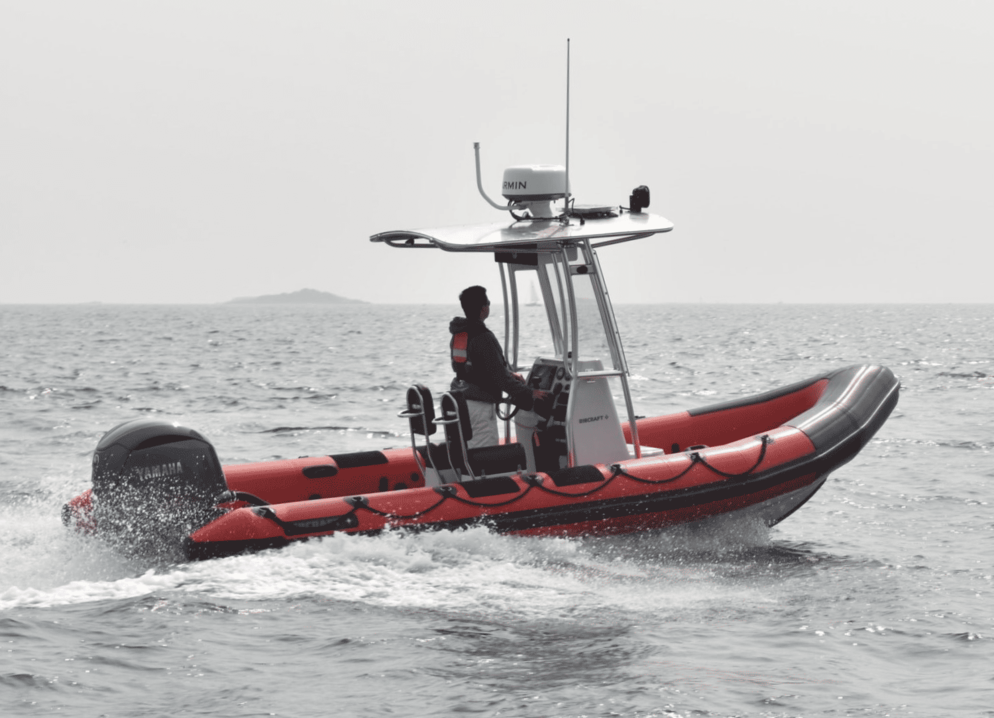
People always ask me for advice whether they're an agency, yacht club, or recreational boater whenever they're in the market for a new RIB. Because of this, I've been meaning to post the top things people should consider when buying a RIB, but my colleage Matthew recently beat me to it. He was asked by WindCheck Magazine in their October issue for the top things people should consider when buying a rigid inflatable boat.
When it comes to fuel efficiency, RIBs have been ahead of their times and the US Market is just catching up. For this reason, RIBS have enjoyed incredible popularity in Europe over for decades.
Unlike the United States until recently, Europe has long suffered from high fuel (petrol) costs. These higher costs forced Europeans to look to smaller fuel efficient cars and smarter more efficient boat designs when it came to on the water activities. As such, Europeans have preferred RIBs over solid sided boats for decades because of their fuel efficiencies.
RIBs sport a light weight design and sleek hulls with far greater planning capabilities. They require less horsepower to achieve the same speeds as solid sided boats because they are lighter weight and have less drag through the water. These design characteristics deliver excellent efficiencies which lead to fuel savings.
With the fuel challenges in the U.S. hitting everyone, RIBs are the answer to stress free boating and represent future of the boating market.
In his August editorial, Soundings Magazine Editor William Sisson, raised the question of whether or not rising fuel costs will fundamentally change how we get out on the water in the decades to come? He stated that the auto industry is in the midst of retooling to produce more energy efficient automobiles and that boat builders will need to do the same. The result, he said, could be a new generation of hulls both lighter and more efficient.
Sisson theorized that perhaps people are going to have to change their expectations about speed, performance and in some cases ride. He wrote: "I suspect we will need to readjust our priorities about what we expect out of our boats". Sisson says that successful planing boats of the future will be lighter, have flatter sections aft, and run on longer narrower hulls – as a result they can be powered by smaller, lighter engines, requiring less fuel capacity but he says you'll have to sacrifice performance in rough weather.
People no doubt will begin looking towards improving fuel efficiencies. For those of you who already own a RIB you already have it. A RIB delivers all of these "futuristic" properties Sisson discusses. But what a RIB doesn't do is sacrifice performance – instead it improves it. So, I agree that people's expectations will change, but it will be that they can finally have their cake and eat it to - better fuel efficiency and better rough weather performance.
A RIB is the boat of the future available today. Gone are the days of people looking to heavy hard-sided boats like Grady White and Boston Whaler. Boaters will now do as they've done in Europe for decades and turn to RIBs.
We recently learned that a fleet of RIBCRAFT used by Chinese fire departments played a critical role in the earthquake rescue efforts. With the roads destroyed, the first rescuers reached the epicenter of the quake by water on board their RIBCRAFT 4.8s. In the photo below you can see a 4.8 delivering additional rescue personnel. Though taken from far away, the photo gives a really good idea as to the extent of the devastation.
Check out the acceleration of this RIBCRAFT 9.0 with twin 225HP Honda engines. Literally one minute you see it and then seconds later it's nothing more than a speck on the horizon. This RIBCRAFT goes from 0 - 40+ knots in just seconds is quite impressive for a 30' boat.
The RIBCRAFT Mitigator returned to the spotlight in a recent episode of CBS’s hit show, CSI Miami. Check out the first five minutes of the episode, "Death From Above" at minute 2:30 and right after the opening sequence at minute 4:58 for the best views of the Mitigator.
At RIBCRAFT, our success in building quality professional grade RIBs is a direct result of our fantastic employees. Since beginning our U.S. operations in 2001, we've experienced significant growth - developing into one of the leading manufacturers of rigid inflatable boats in North America and the entire Globe for that matter. Our meteoric rise is a direct result of great people.
As we continue to strive to deliver the best RIBs and service available, we are always searching for talented and motivated people to join our team. Currently, we're looking for people who want to be part of our exciting and growing company as members of our sales, accounting/ finance department, and production teams.
If you harbor a desire to join an energetic growing company in the only expanding segment of the marine industry that is committed to delivering the best, then send an email with your resume to jobs@ribcraftusa.com.
Military Special Forces were among the earliest adopters of RIBs. The reason, quite simply, is safety, performance, and versatility.
First and foremost, a RIB is ideal for keeping the crew safe while en route to their intended destination. For many Special Forces and tactical teams, a RIB is used as a means of deployment to a land or water based target. They rely on speed for the element of surprise and to insure mission success. While at speed, the crew and members of the tactical team can be subject to severe impacts and harsh elements for long periods of time. A RIB, with its deep V hull and inflatable tube, mitigates that by providing a far smoother and dryer ride than hard sided vessels. A less bruised and battered group of Special Forces is far more capable to perform at the top of their game when they reach their destination.
Tactical forces require an open light weight high speed platform that provides the utmost in sea keeping abilities, maneuverability, and responsiveness. They need a boat whose performance is not only reliable, but predictable. Many tactical forces use their boats to deliver boarding parties to larger vessels – a RIB's maneuverability and inflatable tube is essential for these operations as they come alongside their targets. With the tube a RIB is generally more immune to damage from low speed collisions.
These days with the increased threat to Homeland Security, it's no longer just the military that have Special Forces. Law Enforcement Agencies, both at the state and local level have seen their responsibility grow to include more maritime interdiction and anti-terrorism missions. Even U.S. companies that have manufacturing facilities on larger bodies of water overseas, be they factories or oil platforms, are providing tactical security forces to patrol and protect their interests. Like the early adopters, these organizations rely on the safety, performance, and versatility of a RIB.
Fire departments must always work to meet the many needs of the people they protect. For some, water rescue and the ability to respond to water related accidents are among these. You might be amazed to learn as I was, that in some cities and towns water related incidents outnumber fire-related injuries and fatalities.
You don't need to be located on the ocean to justify or require a fire/rescue boat. Many landlocked towns are using boats on reservoirs, rivers, and lakes. If a town has a marina, homes tightly nestled along the water's edge, thousands of recreational boaters and swimmers be they on a lake, ocean, or reservoir a rescue boat is essential to respond to the inevitable accidents.
Beyond the expected rescue responses, a rescue boat also provides departments with access to remote locations that aren't accessible by land – be it an island or remote wooded area located on a large lake or along the ocean. A proper rescue craft can also assist stranded watercraft, contain hazmat spills and search for drowning victims.
In speaking with fire department and rescue experts, a major criteria for a rescue craft is that it must provide a stable working platform capable of handling a wide variety of emergency situations. A rescue boat should be able to carry a crew of two to five personnel plus their equipment as well as any potential victims. There should be enough open deck space to carry victims on backboards or to be able to administer medical care while on the water. A boat that can only carry one person like a Jet Ski or SeaDoo is useless and not effective for rescues. In addition to stability, a boat must be easy to maneuver in tight locations or in conditions with high winds, rapid flowing water, or in heavy seas. Additionally, it is recommended that the boat is equipped with enough power to provide a cruising speed of 25 to 50 mph.
When considering a new rescue boat, it's important to consider what needs the boat must meet. Does it need to be deployed for each use or moored in the water? Will it be for fire suppression or for search and rescue applications? Who will be using it – trained dive teams or the town's lifeguards?
Most important however is to remember that a fire/ rescue boat is first and foremost a workboat and the boat you decide to purchase should be specified and built as such. Though your local boat dealer may sell a popular brand that's "perfect" for your family's boating activities, it's most likely not going to be up to the challenges your department faces. You need a boat that can withstand the most severe conditions.
The best way to find out what boats are the best for your department is to ask departments that already own them.
When you can't get out on a RIB yourself, the next best thing is to watch a video of one. Take a look at this video of a RIBCRAFT 5.85 cruising through the marshes. Too bad it's not rough, but I think you'd agree this gives you a pretty good idea of what it feels like to be on a RIB.
For more great RIB videos, check out YouTube and search for "RIBCRAFT" or browse the RIBCRAFT website for videos of the RIBCRAFT 9.0, RIBCRAFT 7.8, RIBCRAFT 5.85, the RIBCRAFT 4.8 and the US SAILING RIBCRAFT 15. Stay tuned over the next couple weeks as we add more video to the site and create a video gallery for your one stop shop for RIBCRAFT videos.
I know when you're looking for a new boat, it's not always possible to get out for a sea trial, so hopefully by providing video of our boats in various sea conditions will help paint a picture of what these boats can do. For those of you who already know, they're a great reminder
For those of us in the throws of winter, thought these pictures of people using their RIBs during warmer months or in warmer climates would be a nice reprieve from the cold temperatures. I'm always looking for photos of RIBs "in action" so please feel free to share your pics with us!
Though it’s the dead of winter for those of us in the northern climates, January is a busy month for RIBCRAFT.
We start the month off at the National Sailing Programs Symposium (NSPS) in St. Petersburg, Florida on January 9th-13th. Hosted by US SAILING, this four day event is the pre-eminent sailing education conference in the country. The NSPS provides an excellent opportunity for sailing progams and industry to communicate, share ideas, and learn about pertinent issues in the sport. Having long recognized the needs of sailing programs and yacht clubs for commercial grade safety, coach, and mark boats, RIBCRAFT and US SAILING partnered in February of 2007 to create the US SAILING RIBCRAFT 15. This 15’ RIB, designed exclusively for yacht clubs, sailing programs and sailors alike, will be exhibited at the NSPS and available for demos. This boat is the only boat designed specifically as a coach and support boat.
Changing gears. For those of you looking to see the latest offerings in the RIBCRAFT line of Professional Grade RIBs, we invite you to visit us at The New England Boat Show January 12th-20th at the Boston Convention and Exhibition Center. This is a great indoor show that provides us with a excellent opportunity to show off several of our most popular models.
Continuing on in our support of the sport of sailing, RIBCRAFT is a proud sponsor of the 2008 Rolex Miami OCR in Miami, Florida on January 27th- February 2nd. This regatta will host over 600 sailors in more than a dozen different classes. This has turned into one of the top regattas in the world.
Walking through the production floor today was like looking at an ad for what you can do with a RIB. As I looked at the various boats in production this morning, I was amazed at the variety of customers and their intended uses. There's a 5.85 for a fire department's dive team, two 7.8s for a presidential security force, a 5.85 for a yacht club that will use the boat as a safety and work boat, a 9.0 for an adventure tour company, a 7.0 for a recreational customer who wanted a diesel engine configuration for exploring the San Juan Islands, a 150 for another recreational customer who is buying it for his children so that they can have a boat to use on their own and learn about boat handling, and another 5.85 for a marine research lab.
Whether it's for work or pleasure, a RIB is the ultimate boat for any on water activity. The diversity of our customer's continuously amazes me. How do you use your RIB?
Looking at the video I posted the other day of the woman and her passenger getting thrown from the boat, I am reminded just how much I like the RIBCRAFT pod seats.
First, a pod seat is RIBCRAFT's version of a jockey seat. At first glance most people's reaction is that they don't look comfortable. Some people at boat shows have made such bizarre comments as it looks like an old fashion lunch box or even a mailbox. To an extent I would agree with that initial impression, however, they are anything but uncomfortable and more important they do what their meant to do – keep you in the boat.
A RIB is the ultimate performance boat and though they are designed to go through anything safely, we passengers aren't without help. I like to equate a pod seat to a bucket seat in a high end sports car. You don't see large bench seats in a Porsche 911 or an Aston Martin – that would be ridiculous. If you did, you wouldn’t make it through your first turn on a country road without being instantly flung against the passenger door. Well, the same holds true with a RIB. Though a leaning post is more "mainstream" and accepted in the boating world, a pod seat offers the same support as the contoured seats of a sports car.
Pod seats provide optimal support and comfort in heavy seas and at high speeds. With a high backrest and high density conforming rounded cushion seat, the pod seat anchors the individual into the seat and allows the operator to use their legs to absorb the wave impacts while providing full support to the lower and upper back. Additionally, with a high backrest, the pod seat allows the individual to stand, using the backrest just like a leaning post except with a pod seat they have the ability to use the inside of their legs to brace against the pod base which is conveniently located between the knees through tight turns. The height and width of the pod seat is designed to comfortably fit between your legs, which takes advantage of the fact that we all stand with our legs a shoulders width apart on a boat for balance. This allows the individual to use their knees to steady or brace themselves against the pod seat cushion to provide additional support?
Had the driver of the speed boat been sitting in a pod seat, I'm sure she would have stood a better chance of staying with the boat. For those of you who have pod seats (or don't) what do you think?
It was a made to order day for RIBs; sunny, 70 degrees, 20-25 knots of breeze, and 3'-4' seas. Our RIB Rendez-Vous on Saturday was a great success and lots of fun. 10 RIBs gathered in Marblehead and en masse we headed out of the Harbor in a scene that Dan Tucker mentioned was reminiscent of Apocalypse Now.
As we made our way to Boston, a small craft advisory was issued and the area yacht clubs cancelled the day's sailboat races due to too much wind. The day was definitely a testament to RIBs. With the 3-4' waves and strong steady breeze, there wasn't one of us who were dry by the time we made it into Boston (less than 40 minutes I may add). As we sat and ate our picnic lunch at the Courageous Sailing Center in the heart of Boston Harbor, we all agreed that we couldn't wait to get back out there but couldn’t imagine doing the same thing in a hard sided boat!
After we ate and had a chance to dry off, we headed through the Charles River locks and up the Charles River to Boston University's boat house where we turned around and headed back. It was beautiful and so peaceful on the river that most of us forgot what was waiting for us on the other side of the locks (20+ knot winds and big wet seas). But after a great lunch and the re-charge on the river, the passage back to Marblehead was loads of fun (still wet, but can't beat a fun and exhilarating ride).
We had a great time on the water and are looking forward to another outing!
Take a look at some of the photos I've included below and enjoy!
Matthew Velluto (filling in for Fred)
All of us gathering at the Town Dock in Marblehead before venturing out.
Some of the RIB armada heading out of Marblehead Harbor.
Two RIBCRAFT 7.8's making their way up Boston Harbor (finally calm enough that I can take some pictures)
Having some lunch at Courageous Sailing Center in Boston Harbor
Here's the flotilla tied up at the Couragous Sailing Center after the first leg of the trip!
Quite a sight to see a bunch of RIBs all lined up in the locks - the Lock Operator had no idea what to make of it!
RIBCRAFT Continues To Be At the Center of Sailing Programs and Regattas Around the Country This Summer
From California to New Jersey and Texas to Wisconsin, every day there are coaches teaching children how to sail from their US SAILING RIBCRAFT 15 and race committees setting marks from a RIBCRAFT mark boat. Here's a partial list of clubs and sailing programs who use their professional grade RIBCRAFT RIBs every day for race management and junior sailing.
American Yacht Club
Annapolis Yacht Club
Bayhead Yacht Club
Beachwood Yacht Club
Chapaquoit Yacht Club
Coronado Yacht Club
Corinthian Yacht Club
Houston Yacht Club
Hyannis Yacht Club
Indian Harbor Yacht Club
Island Heights Yacht Club
Kennebunk Beach Improvement Association
Lavallette Yacht Club
Larchmont Yacht Club
Manasquan River Yacht Club
Mantoloking Yacht Club
Metedeconk River Yacht Club
Milwaukee Yacht Club
New York Yacht Club
Normandy Beach Yacht Club
Ocean Gate Yacht Club
ine Beach Yacht Club
Pleon Yacht Club
Seaside Park Yacht Club
Shore Acres Yacht Club
Shrewsbury Sailing & Yacht Club
Stamford Yacht Club
Toms River Yacht Club
US Sailing Team
Watch Hill Yacht Club
Wianno Yacht Club
Congratulations are in order for RIBCRAFT customers Bob and Farley Towse and their 66' sailboat, Blue Yankee for taking line honors (first to cross the line) in the Marblehead to Halifax Ocean Race Race. Here at RIBCRAFT we like to believe that their RIBCRAFT 5.85 that is used as a tender to Blue Yankee contributed to their success, but I'm sure it had more to do with their crew's ability than their RIBCRAFT.
For many yacht clubs and summer camps, this week marks the start of their junior sailing programs. With that comes hundreds of excited children making their way down to the docks for the first time of the season. For some that excitement is trepidation for the dreaded swim test, while for others it’s an eagerness to dust off the cobwebs and get back on the water.
For instructors their excitement is much the same. Yes, they dread the swim test too (but for different reasons I’m sure), but for some their excitement is one couched in anxiety at seeing the caliber of sailors they’ll have this summer, and for many the excitement is a concern based on the question that’s always in the back of their mind of whether or not the coach boat will start when they need it, what’s broken now, and will it be functional. For the lucky coaches (and clubs) that have purchased the new US SAILING RIBCRAFT 15 this summer, I’m happy to say that that’s one thing they won’t have to worry about.
Built off of the existing RIBCRAFT 4.8 that has served sailing programs and yacht clubs gallantly for years, the US SAILING 15 is the culmination of valuable feedback from sailors. Intended for US SAILING members, ranging from individual sailors looking for a great runabout to yacht clubs needing a reliable support boat, the US SAILING 15 with its simple clutter free layout is the ultimate coach boat for junior sailing programs.
Less is always more when it comes to sailing programs. If you have any experience with junior sailing programs you know that if it can break – it WILL. With that in mind, the US SAILING 15 features a center console, stainless steel lifting points, lots of open deck space, and a 40HP four stroke Mercury outboard. This simplicity combined with the durability and performance of the boat, makes the US SAILING 15 a worry free safety boat for coaches.
Give us a ring or drop an email if you or your club is interested in trying out the new US SAILING RIBCRAFT 15! info@ribcraftusa.com or 781.639.9065
Here’s the ultimate option on a RIB for someone who has it all! These thru-hull underwater lights not only make your boat stand-out in the crowd, I hear they attract marine life to the surface. Some search and rescue groups have even used these underwater lights (clear instead of blue) for searching in clear waters.
Ahh – as the weather get’s nicer – so do the sea trials. Making it even more enjoyable is a fantastic boat with the perfect layout. I just sea trialed a 25’ RIBCRAFT 7.8 built for a recreational customer who is going to use the boat for use as a tender for his fleet of sailboats. The boat featured a center console, leaning post, fore and aft tow posts, and a transom extension which allowed for our newest feature, an aft bench seat. All metalwork was completed in stainless steel – making the final appointments refined and flawless.
Not only did the boat look great – it performed beautifully. With a small chop and a westerly 15 knot breeze, the boat easily popped onto a plane and maneuvered empty moorings in the harbor like a professional slalom skier. Perfect for recreational use – this layout would work great for harbormasters, yacht clubs, and marine patrols.
Don't forget to check out the new bench seat. Shown here in stainless steel - the bench is also availabe in aluminum.
Add A Touch of the RIBCRAFT 5.85 And A Touch of the RIBCRAFT 7.8 and You Get...
A truly great RIBCRAFT 6.8! We sea trialed one of our new RIBCRAFT 6.8s and the boat’s performance exceeded our expectations. With a steady north easterly breeze funneling down Marblehead Harbor producing a steady 2-3’ chop, it was a made to order day for a RIBCRAFT sea trial. Equipped with twin 90HP Honda four strokes, the 6.8 performed beautifully, smoothly slicing through the chop without an ounce of salt spray touching the tubes.
I’m a huge fan of the 19’ RIBCRAFT 5.85 and the 25’ RIBCRAFT 7.8 and I have to say that the 6.8 seemed to be made specifically for my likings. It had the maneuverability and agility of the 5.85, yet the power and balance of the heavier offshore 7.8. Though it was a cold and dreary day, I didn’t want to get off the water – the 6.8 made me want to stay out there all day.
Here are some pictures of the boat. This boat is equipped for diving, however with a center console and single or twin engines, the 6.8 would be an excellent patrol craft and the ultimate pleasure boat.
What do you do with a RIB?! It’s a question I used to get all the time, but these days with RIBs becoming more prominent in US waters the question comes up less and less. It’s too bad in some ways – because that question really speaks to the versatility of a RIB. As I’ve said countless times before in answering this question, with a RIB you can do everything you do with a hardsided boat, only much more. I recently scanned a list of our customers and to my own amazement I was quite impressed with the multitude of activities our RIBs are used for.
For Work our customers use their RIBs for: Coaching, Law Enforcement, Search and Rescue, Patrols, Security Work, Interdiction, Education, Philanthropy, Tourism, Officiating, Diving, Towing, Research, Exploration, Salvage, & Transportation.
For Play our customers use their RIBS for: Entertainment, Adventure, Cruising, Fishing, Hunting, Exploring, Spectating, Family Fun, Escapes, Diving, Thrills, & Enjoyment.
I know I missed some, but I think you get my point. How about you? What do you use your RIB for?
I just got back from a fantastic sea trial. As part of our quality control program, we sea trial every boat prior to delivery. Each boat is taken through the paces and pushed to the limit to insure everything is functioning properly. Should there be any failures we want to know about them before the boat leaves our facilities so we can fix them while the boat is still in our possession.
This morning I was fortunate to get out on two identical RIBCRAFT 4.8 Rescue Craft. These two boats performed perfectly. I’ve been on hundreds of sea trials and they just don’t get old. Whether with prospective customers, marine editors, or colleagues, the 4.8 is one boat that never disappoints!
The two 4.8s were equipped with the 60HP Mercury Big Foot four stroke engine. Though not always a favorite of our riggers, these 60HP engines moved the boats perfectly. Topping out right around 40 mph, the boats easily held through the turns at full throttle. What’s more there was zero cavitation. I hope to have the pictures I took of the boats tomorrow - I’ll be sure to post when I have them.
I’m often asked why the consoles on RIBCRAFT models appear to be placed further forward than many of our competitors. It’s a great question - and as you can imagine their placement isn’t done simply by happenstance or by some marketing guy who thought it was a great marketing gimmick.
BALANCE
One of the chronic problems with RIBs is that they tend to be extremely stern heavy and can struggle when it comes to getting the bow to come down while coming onto a plane. We’ve all seen RIBs with the bow shooting high into the air. This is extremely problematic – not only do you lose visibility, but it can be very unnerving. By placing our consoles forward, we improve the overall balance of the boat by offsetting the weight of the engine(s) with the weight of the operator. You will find that a RIBCRAFT RIB easily pops up on a plan and rides nice and flat. Though this is a function of the great hull design, it is also greatly assisted by console placement and improved weight balance.
RIDE
Another reason for placing the consoles a little further forward is that they are located over the deepest and sharpest point of the V hull, delivering a very smooth entry into the water with virtually no pounding for the operator. Additionally, by being slightly further forward, it’s a much dryer ride for the operator by taking full advantage of the high bow sheer.
VISIBILITY
Not only is a dryer ride more comfortable – it’s also much safer as the operator doesn’t have to deal with wiping salt out of his or her eyes or seeing through a water soaked windshield. Additionally, by placing the console forward we improve the operator’s visibility by having them in the middle to front of the boat. Whether you’re using the boat for work or pleasure, it’s essential to have an unobstructed view of where you’re going. Too often the driver has to look over, through, or around their passengers to simply see where they’re going.
DECK SPACE
Lastly, but no less important, one of the trade offs we hear with a RIB is the decreased deck space. However, by placing the console forward we maximize useable deck space on the RIB. By having the console forward we leave the widest part of the deck open for gear and seating arrangements.
Show your RIBCRAFT Pride with new RIBCRAFT T-Shirts, Polo Shirts, Hats, and Window Decals. Click on "RIBCRAFT Gear" on the RIBCRAFT home page to order your own shirts and hats today. Whether you own a RIBCRAFT or not, everyone looks good sporting RIBCRAFT Gear!
Check out this great video of a 21' RIBCRAFT 210 underway in what looks like 1-1.5' chop. Nothing runs like a RIB as these two RIB junkies know! In case you're wondering, the footage was shot from a 25' RIBCRAFT 7.8 Mitigator.
It was the first real nice day of the season here, so I decided to head out on a RIBCRAFT 5.85. You could tell too by the number of SeaTow, Tow Boat/US and Harbormasters out responding to breakdowns - that for many this was the inaugural cruise of the season and the excitement of the moment didn’t magically put fuel in their tanks or fix their engine problems from last year.
It was a rough day with a strong westerly breeze that made for a wet rough ride for anyone not in a RIB. I am still amazed to see the area Harbormasters and towing companies struggle with their hard-sided boats in theses kind of conditions. As I sped comfortably by at 25 knots, it was a sad sight to see the harbormaster in his 25’ hard-sided center console with a T-Top and blue light flashing slowly flogging their way out of the harbor. Not making more than 10 knots, the two officers clinging to the top were soaked as the wind caught the spray and blew it into their faces – definitely obstructing their vision. I couldn’t tell if they were going slow because they couldn’t see where they were going or if it was just too uncomfortable to ride on a plane. Either way, neither of those would be an issue if they were in a RIB.
At another time in the day, I painfully watched as one of the tow companies struggled to come along side a stranded vessel. They were pitching back and forth in the 2 foot chop and the operator was concentrating more on keeping his finders over the side so as to not damage the two boats than focusing on driving. With a RIB, they could easily come along side the boat with a one-track focus of successfully securing the tow on a stable and predictable platform.
I almost felt guilty as I easily sped by the professionals, but all I could wonder is why they didn’t have a RIB. Each day, we see more and more safety professionals catching on to the benefits of a RIB. The departments that use RIBs today, can't imagine doing their job in any other kind of boat. It just amazes me that so many are resistant and slow to change.
To Sea Trial or Not To Sea Trial – There Is No Question
Matt Provenzano, RIBCRAFT’s Director of Operations
When folks ask me why I spend so much time on our boats, I quote Kenneth Graham’s famous line, “There’s nothing, absolutely nothing, half so much worth doing as simply messing about in boats.”
My goal since I started at RIBCRAFT was to build the best RIB in the industry, period. And spending large amounts of time on the water on our RIBS as well as our competitors’ boats is the best way I have found to flush out desirable and undesirable characteristics. As everyone at this company will attest, I don’t go “boating” - I go out with the sole purpose to put these boats to the test every time I hit the water. The Sea has a way of finding any kink in the armor and exploiting it. My goal and job is to find that kink first.
I typically spend at least two days a week on the water sea trialing boats. At RIBCRAFT we sea trial every boat that leaves our factory with an engine. I would argue that the sea trial is one of the most critical parts of the building process. It allows for the evaluation of a boat’s performance, machinery, controls and operating systems in addition to the overall comfort and safety of the boat. Prior to any sea trial, our quality control manager runs the boat through the paces on the hard. (RIBCRAFT’s quality control process inspects and evaluates over 300 different aspects of the boat.) Even after all this and primarily out of habit, I go through the boat personally before I splash her.
Here’s a small list of what I typically look for:
•First, I look over the tube to ensure that all tube seams and patch work is tight, the tube is holding air, and each of the chambers is inflated evenly. Running a RIB at low or uneven pressures will in short order ruin a set of sponsons. Optimal tube pressure is between 3.0 and 3.5psi.
•Second, I thoroughly inspect the hull. First I check to insure the hull is clear of scratches or damage. I then climb aboard and open every hatch and to look inside. Additionally, I check to make sure there are no scratches to the gelcoat. After all the fiberglass components are inspected, I look at all hinges and fasteners making sure that each is properly installed.
•Next, I look over the boat’s electrical systems. I test all electrical systems to ensure that they are operational. VHF and UHF radios are tested to ensure clear transmissions. I also check wire and battery terminations in the console to make sure that all wires are secure and protected from chafing hazards. On our larger boats, I look over wiring on the arches and radar towers. Our guys do a great job with installing electrical systems that exceed ABYC and USCG standards and it is rare if I encounter any issues in this area.
•Finally, I inspect all mechanicals. I always start with the steering system. Turn the helm lock to lock. Note any feelings other than pure smoothness. On hydraulic helms check to make sure the oil level is topped up, while rotating the helm visually inspect for leaks at hose terminations and throughout the hose run. I also always pop the cover on the engine and check vital fluids before I make my way to the harbor. At the same time I ensure, throttle and shift cables are tight and locking pins have been installed. Once the boat is fueled, I evaluate all fuel fittings and tank penetrations to ensure there are no fuel weeps. Checking bilge pump operation is critical as is checking for or removing any debris in the bilge that could choke a pump.
When practical, it is best to put the boat through its paces in reasonably windy and bumpy conditions. RIBS truly show their colors when the weather picks up. I have weathered conditions in RIBs that most boats just simply could not handle. Once on the water, I run the boat at varying RPM’s and record engine and performance statistics for each boat. Here is a small list of what I also check while on the water:
• Tachometer reading at wide open throttle
• Constantly watch all engine gauges and alarm indicators
• Check throttle and shift detents and tension to ensure proper adjustment
• Inspect helm and steering linkage at all bolted connections
• Check for fuel leaks and fume build up
• Recheck electrical equipment operation and verify bilge pumps are working
• Check for any water leaks.
• Once back at the dock recheck all engine fluids and bilge levels.
If you ever find yourself in Marblehead and you would like to go for a ride please call and I will personally take you out myself. Just remember your foul weather gear.
I was fortunate enough to get out on a RIBCRAFT 7.8 on the Pacific Ocean the other day with a customer in Ventura California. What a beautiful day in Southern California, the sun was shining, a nice gradual swell was rolling in, and the 2 foot chop made for ideal conditions for a RIB ride and for the dolphins that joined us.
When it was my turn at the wheel, I put the boat to the test – cutting in among the surf and pushing the boat through tight figure eight turns. As always – I’m continuously amazed by the performance of a RIB! The RIBCRAFT 7.8 we were on is a machine – complete with twin military spec 150HP Johnson Enforcers, a shock mitigating seat for the operator and two aft pod seats for crew. This boat is used by Channel Watch Marine, a Vessel Assist Tow and Salvage operator.
As a commercial tower, it’s an excellent platform for their business. The 25’ RIBCRAFT 7.8, allows them to quickly get on the scene of a tow or salvage operation. Though not usually the boat to do the towing, the 25’ RIB enables them to secure the situation, rescue passengers in harms way, quickly understand the needs of the situation, and finalize any paperwork. With the RIB, they’re able to easily do 20 knots in large seas and 30+ knots in calmer conditions while their hard-sided tow boats can only make 6-12 knots depending on the conditions.
Furthermore, with a RIB, they don’t have to worry about damaging the topsides of the distressed vessel either. They’re extremely happy with their new addition – but as I mentioned last week in a posting, they’ve had to adjust they way they do certain things. Hip towing vessels has taken some modifications as there are fewer tie off points on a RIB. With the tubes, they can’t always fully snug up the lines. These aren’t negatives by any means, but just things they’ve noticed and have found solutions for. In all respects, a RIB is an excellent platform and asset for their business.
This past weekend I was fortunate enough to go boating. I took to the water in a new RIBCRAFT 190 featuring our brand new leaning post. It had been a while since I was on a RIB with a leaning post and to be honest it was a nice change. I must say that I enjoyed the space and clean look it provided. Now a standard option on the new RIBCRAFT 190, customers can choose either the more mainstream leaning post or two jockey style pod seats as part of the base boat. Though I liked the comfort of the leaning post while cruising around the harbor, after my ride today, I still much prefer the peace of mind, safety and comfort the pods offer while underway. With the pods I have the option to either sit or stand, but no matter what, I know that I am fully supported and secure in the boat. While standing, using the backrest just like a leaning post, I also have the ability to use the inside of my legs to brace against the pod base conveniently located between my knees for tight turns. And for longer passages, I can also safely and comfortably sit. Through the combination of the overall seat design, cushion density and body position, I’m completely comfortable regardless of how rough it gets. For me, the pod seat offers just about everything a leaning post can, but more. The pods are my choice.
With the opportunity to choose for yourself, what would you pick – the pods or leaning post? If you own a RIB with either of these, what do you think?
For some reason, RIBs don’t share the same popularity here in the United States as they do in Europe. But their acceptance and reputation is growing leaps and bounds; in fact the RIB market is the fastest growing segment of the marine industry in the States today. Even still, Europe, and especially the UK, is about a dozen years ahead of the US RIB market. Brits have long enjoyed the many advantages of RIB’s while the vast majority of boaters here in the US are just beginning to understand what these boats are all about.
One of the best indications of how RIB popularity is gaining strength comes from evolving perceptions at boat shows. We started keeping track of people’s reactions and comments at recreational boat shows four years ago, at that time their comments said it all: “what is it?”, “what do you do with a boat like that?”, “those seats look like mail boxes”, “it must be like riding a horse”, “do you use the tubes to store fuel?” But with each year, acceptance and understanding of RIBs began to take hold as RIBs become more prevalent at shows and on our waters. Now the entertaining comments have all but ceased. Today, we’re at the point where everyone has probably at least seen a RIB. They may not fully understand the many benefits, but they’ve noticed the Coast Guard, local police or harbormaster, and even their own yacht club using RIB’s. With that comes understanding, acceptance, and a willingness to give them a try for themselves.
The challenge is, distinguishing a RIB – a RIGID inflatable boat from an inflatable dinghy or tender. Like anything new, an early bad experience can leave a sour taste in one’s mouth. We’ve talked to many people who think they’ve tried a RIB. Some equate the performance of their roll-up soft bottom dingy to a RIB or they’ve bought a yachty looking thing with lots of white cushions and cup holders and expected it to be the ultimate SUV of the seas. There is a big difference between a cushy yacht tender, a roll-up, and a RIB! Once they get out on a genuine RIB, they see for themselves what a RIB is all about – unbelievable performance, incredible safety, and unbeatable fun. After they’ve taken a spin, they’re hooked.
Today, those who own RIBs are proud to have something different. Something their neighbors don’t have. RIB buyers tend to be well educated, accomplished boaters, and thrive on being pioneers. In many cases, they’re looking for something new and an alternative to their generic looking solid sided boat that they get beaten and bruised on every weekend when there’s a chop or rough seas.
There’s almost a cult like following among RIB owners in the US. They love to talk to other RIB owners here and abroad – something you’d never see from the 20’ center console, solid sided crowd! RIB owners compare what they like, don’t like, how they use their boat, how it’s configured, powered, and equipped, and what kind of seas they took their RIB out in. There are even a couple of great online chat rooms that help facilitate these discussions; RIBnet & HOT RIBS, check them out!
The RIB market in the US is evolving and growing. It’s still very much in its infancy, a new frontier really, but all of us, RIB owners and manufacturers alike are proud to be sculptors shaping and forming the market. Pioneers in a way.
We want it, you deserve it. Welcome to Fred’s Blog. As the first Blog dedicated to RIBs in the United States, we want to make sure our customers and all RIB enthusiasts are front and center. This blog was created for you.
Fred’s Blog is your resource for the latest thoughts and ideas from all of us at RIBCRAFT on topics pertaining to RIBs, RIBCRAFT and our boats (professional & recreational), and the RIB world as a whole. Basically, anything that’s relevant and important to your personal RIB experience. We hope you find this helpful and entertaining.
To that end, please feel free to post comments and share your thoughts on what we have to say. Good and bad, we’d love to hear them all. As one of the few RIB manufacturers in the U.S., we want to be a resource, not just for RIBCRAFT customers, but for all RIB owners in the United States. Bookmark this page and check back often as we discuss all things RIB; from the latest trends in design & construction to easy maintenance and care tips for your RIB, to new model launches from RIBCRAFT and others. If it has to do with RIBs, it will likely be discussed here.
We look forward to an open exchange of ideas, comments, and feedback that will lead to improving the RIB experience for all of us.
"RIBCRAFT", "RIBCRAFT USA",
and "Rib
Craft" are trademarks of RIBCRAFT USA, LLC. Copyright 2005.
All Rights Reserved. RIBCRAFT USA reserves the right to change,
without notice, any pricing, materials, specifications, equipment
and/or accessories.